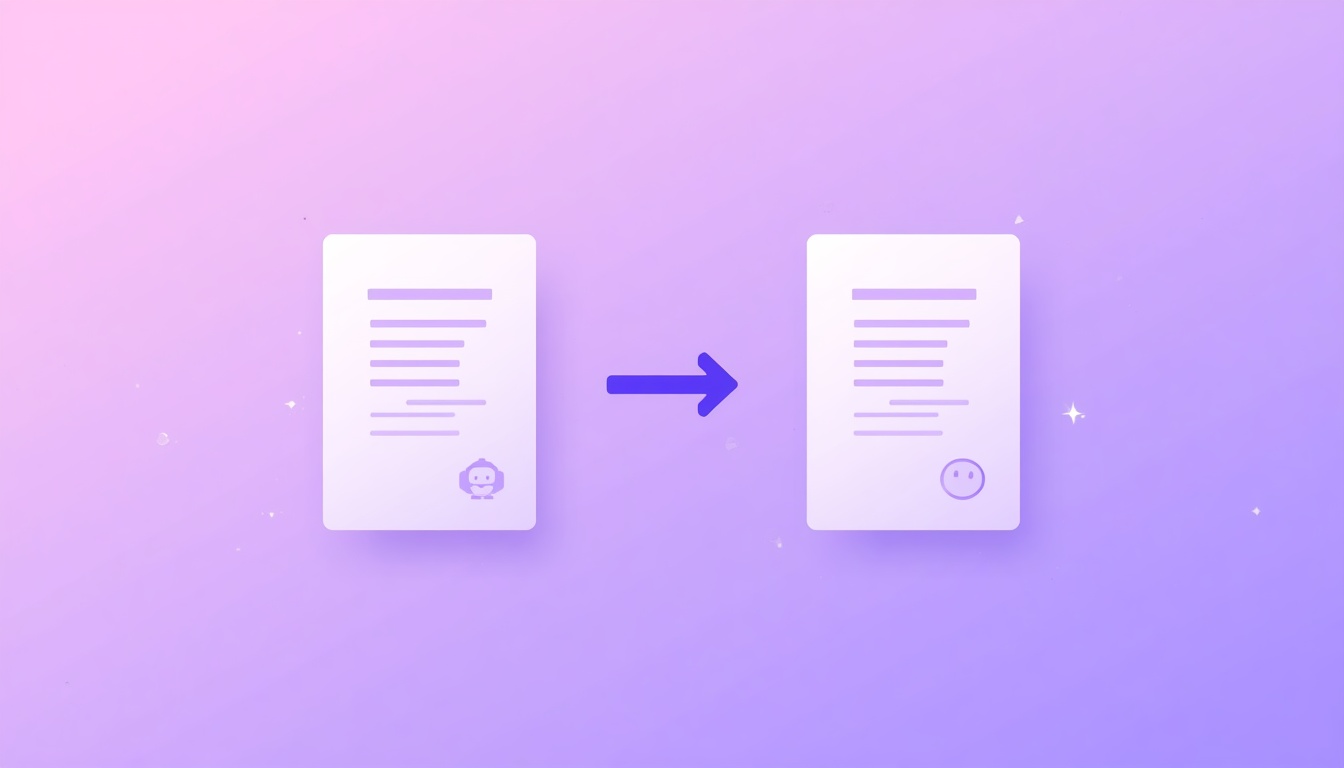
Most AI humanizers just shuffle words around. Here's what really makes AI-generated text read as human — what detectors actually catch, and the workflow that produces content people want to read.
Every content creator, marketer, and student in 2026 has the same problem: AI writes faster than humans, but it writes in ways that detectors flag and readers tune out. The fix isn't running text through a "humanizer" five times until the AI-detection score drops. It's understanding why AI text gets flagged in the first place and rewriting strategically — usually with the help of a tool, sometimes by hand.
This guide explains what actually makes text read as "AI-generated," what humanizers really do, the realistic limits of detection-evasion in 2026, and how to publish AI-assisted content that genuinely sounds human.
Why AI text gets flagged (and why readers can tell, too)
Large language models like GPT-5 and Claude produce text with statistical patterns that differ from how humans write:
- Lower burstiness — humans alternate between short, punchy sentences and longer winding ones. AI produces sentences of more uniform length.
- Predictable word choice — given the same prompt, an AI tends to pick the same "next word" a human writer might pass on for a fresher one.
- Overuse of certain transitions — "Moreover," "Furthermore," "It's important to note that," "In today's fast-paced world" all appear far more often in AI text than human text.
- Hedging language — "may," "can," "could," "potentially" everywhere, because the model is trained to be cautious.
- Symmetric structure — three-bullet lists, three-paragraph sections, "first... second... third..." patterns. Humans break the pattern; AI maintains it.
- No personality — no anecdotes, no specific names, no contrarian takes. Just a clean, balanced, agreeable summary.
This is also why readers feel AI text is "off" before any detector tells them so. Humanizing isn't gaming a tool — it's making the writing actually sound like someone.
What AI humanizers actually do
A humanizer takes AI-generated text and runs it through a second model trained (or prompted) to:
- Vary sentence length — break long ones up, combine short ones, add the occasional fragment.
- Swap predictable words for less common synonyms — "demonstrate" → "show," "utilize" → "use," "subsequently" → "then."
- Remove or rewrite hedging phrases — "It is widely believed that" → "Most experts agree."
- Add small irregularities — contractions, occasional sentence-ending prepositions, the kind of pace shifts humans make naturally.
- Strip AI tells — phrases like "in conclusion," "delve into," "tapestry of," "navigate the landscape of" that have become hallmarks of AI writing.
A good humanizer does this without losing the meaning. A bad one introduces typos, weird syntax, or hallucinated facts to "look more human." Watch out for the latter — they can make detection worse, not better.
The honest truth about AI detection in 2026
Detectors and humanizers are in an arms race, and neither side is winning cleanly. Some real-world facts:
- GPTZero, Originality.ai, Turnitin AI, and similar tools all have false-positive rates that real teachers and editors should worry about. Studies in 2024-2025 found 1-15% of genuine human writing flagged as AI, depending on the text.
- A confident "100% AI" detection score is often wrong, especially on short text, technical writing, formal academic prose, or text by non-native English speakers (who often use simpler sentence structures, which detectors misread as AI).
- A "humanized" piece can still get flagged if the underlying ideas, structure, or framing are clearly machine-generated.
- Humans writing in a clean, formal style can be flagged as AI — particularly if they're concise, well-edited writers.
The takeaway: don't treat AI detectors as truth machines. They're probabilistic. Use them as a signal, not a verdict. And if you're publishing for humans, the right goal isn't "fool the detector" — it's "actually read well."
A realistic workflow for AI-assisted writing
1. Generate a solid first draft
Use ChatGPT, Claude, or whatever you prefer. Give it a detailed prompt with your audience, tone, examples, and any specific facts to include. The better the prompt, the less rewriting you'll need.
2. Run it through a humanizer
This handles the mechanical part — sentence variation, AI-tell removal, word swapping. Our free AI text humanizer does this in your browser with no signup and no length limit on what you paste in.
3. Add what AI can't add: specifics
This is the step nobody can skip. Humans write with:
- Named examples — "Stripe's pricing page," not "many SaaS pricing pages"
- Numbers — "increased signups by 23%," not "significantly improved signups"
- Opinions — "honestly, I think most marketing automation tools are over-engineered," not "marketing automation tools have varying levels of complexity"
- Personal experience — "When I tried this on a client site in March..." not "When implemented properly..."
- Counterintuitive takes — disagreeing with the obvious answer is one of the strongest human signals
Add 2-3 of these per section. This single step does more for "humanness" than any humanizer.
4. Check the result with a detector (optional)
Run the final version through one or two detectors as a sanity check. If they still flag heavily, it usually means the structure is still AI-shaped — symmetric headings, three-point lists everywhere, predictable paragraph length. Break the structure manually.
5. Read it out loud
Whatever sounds robotic out loud will sound robotic in the reader's head. This catches things detectors miss and detectors flag things this misses. Both matter.
What the best AI-assisted writing looks like
The goal isn't text that pretends to be human-written. It's text that is written by a human — using AI to handle the boilerplate, the structure, the first-pass drafting — while keeping the human in charge of the perspective, the examples, and the voice.
A well-edited AI-assisted article in 2026 looks like:
- AI drafted the structure and the safe explanatory bits
- Humanizer cleaned up the obvious tells
- A human added 4-6 concrete examples, 2-3 numbers, one strong opinion, and one paragraph the AI never would have written
- A human edit pass tightened the prose, broke up the rhythm, and trimmed the conclusion
That last hour of human work matters more than the first three of AI generation. The AI was the typist; the human was the writer.
Common questions
Is using AI to write content "wrong"?
Depends entirely on context. Academic submissions where you're being graded on your own thinking — yes, that's plagiarism. Marketing copy you're publishing under your own brand — perfectly fine, as long as the final product reflects your judgment and is factually correct. The rule of thumb: if you're standing behind it, you should have shaped it.
Will humanized text pass Google's AI content policy?
Google's stated position (echoed by its March 2024 Spam Update) is that AI-generated content is fine as long as it's helpful, original, and serves the reader — not generated at scale just to manipulate rankings. Humanizing alone doesn't get you there. Adding genuine expertise, examples, and editorial judgment does.
Can detectors tell if I used a humanizer?
The newest detectors specifically train on humanized output and try to flag it. Some are decent at it; most aren't. Either way, the gap closes fastest when you stop optimizing for the detector and start optimizing for the reader.
Do humanizers change the meaning of the text?
Good ones don't. They preserve facts, claims, and structure — they just rephrase. After humanizing, always read the output to verify nothing important was distorted. Lower-quality humanizers occasionally hallucinate substitutions ("doctor" becomes "physicist," which changes everything).
What's the difference between humanizing and just rewriting?
Humanizing is a narrow transformation: change word choice and rhythm without changing structure or meaning. Rewriting is broader: change structure, ordering, framing, and tone. The deepest "human" results usually need both — humanize first as a baseline, then rewrite the parts that still feel off.
The bottom line
AI text gets flagged because it reads as AI text. The fastest fix is a humanizer; the real fix is editing in the things AI can't make up — specific examples, real numbers, genuine opinions. Run drafts through our humanizer for the mechanical cleanup, then spend the last 30 minutes adding what only you can add. That's how AI-assisted content stops sounding like AI.
Humanize AI text free →
No comments yet — be the first to share your thoughts.
Comments are moderated and appear after review. Your email is never shown publicly or shared.